08 9393 3373
08 9393 3373
08 9393 3373
VETERINARY HOSPITAL
FARM ANIMAL SERVICES
At West Coast Vets, we understand that your livestock are more than animals — they’re your livelihood. Our dedicated farm animal team provides professional, reliable veterinary care to support the health, productivity, and welfare of your herd.
We work closely with farmers across the region, offering preventative healthcare, emergency services, herd health planning, fertility management, vaccinations, disease control, and on-farm consultations. Whether you manage a large commercial operation or a small family farm, we tailor our services to meet your specific needs.
Our experienced veterinarians combine practical knowledge with modern veterinary medicine to deliver results you can trust. We’re committed to helping you maintain healthy animals, strong performance, and sustainable farming operations.
West Coast Vets — Supporting Farmers. Protecting Livestock. Strengthening Rural Communities.
-
Obstetrics (Caesarean)
-
Pregnancy testing
-
Wounds
-
Medical emergencies
-
Fractures
-
Urinary tract blockages
-
Egg bound birds
-
Tusk trimming
-
General surgery


Case Study
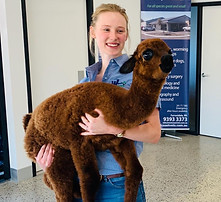
This week's case study is a particularly adorable one - meet Zanzibar the 3 month old alpaca! This little guy presented to our hospital after sustaining a severe fracture of his hindlimb.
This particular fracture involved the 3rd and 4th fused metatarsal bones, which are equivalent to the cannon bone in the horse. The fracture was carefully repaired under general anaesthesia using an orthopaedic plate and screws. He then spent 5 days in hospital on strict bed rest and cuddles, before heading home with his devoted owner to continue his recovery.
Zanzibar is doing great, and has a bright future ahead in the show ring. Next stop, the Perth Royal Show!

Case Study
Just like foals, calves can get joint infections. This little girl has had both knees flushed surgically and injected with antibiotics. West Coast Vets deals with all species and we love our cattle.

Case Study
Horny goat? Our vets recently faced a challenging farm animal case involving a horny goat! Poor Lucy developed cystic structures on her ovaries which caused her to feel constantly randy.
She was perpetually licking, nuzzling and mounting her friends. As you’d expect, her human and animal companions soon got tired of this sort of behaviour and gave us a call. Lucy’s abnormal ovaries were diagnosed using ultrasound and blood tests, and the problem organs were removed earlier this week.
She is making a fantastic recovery and we are thrilled to report that her ‘horniness’ is already beginning to improve.

Case Study
We love treating all creatures great and small! This poor steer presented with a very nasty jaw fracture. Dr. Garnett and Dr. Maxwell were able to repair the injury with the use of orthopaedic wires and many sutures.
He has made a full recovery following this injury and is now a very happy young man.

Case Study
'Little Rascal' is a 7 month old pygymy goat who presented a sudden onset of lameness and was diagnosed with biaxial P1 Salter Harris Type 1 fractures in the left forelimb.
Dr Kristen administered a brief IV anaesthetic, reduced the fractures and then placed the leg in a cast for 6 weeks.
Follow up x-rays showed the fracture to be healed!

Case Study
Star 7 day old Cria, born slightly premature and not really thriving/doing well. It didnt get colostrum so needed a plasma transfusion to boost its immunity. She responded really well and now is suckling off mum.
Still has a fair bit to go until full tick of health, so having regular check in with Gav.


Case Study
Barbie Norrish is 2.5year old goat, presented acutely lame. Her hooves were slightly long, but the front left must have had an injury at the top/coronary band, and subsequently the side of that hoof was severely underrun and damaged.
Aggressive hoof trimming and daily betadine foot soaks (very good patient) allowed this to harden up, prevented it becoming infected and over the last 3 months (photo of foot outside on grass) the hoof is growing back out very well.
Hoof trims in sheep and goats should be performed regularly, every 3-5 months depending on where they live and what they walk on etc.

Case Study
Rufus, a lamb who was found stuck in a fence and rescued. His foot wound didnt respond to medical therapy and was severely infected (foot was dead). The owners were incredibly attached to Rufus so wanted to give him a chance so we decided to amputate the foot. A mid tibial amputation was performed.
Rufus was up and walking within 10 minutes of surgery being finished. He has been an absolute champ during recovery. Stitches came out this week and he is going well!
The owners have gotten him a duck brother named franklin
Case Study
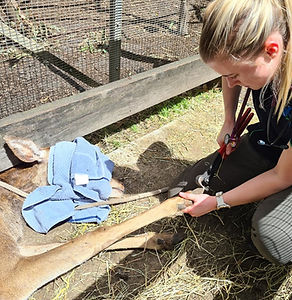
Zoo day: Nora the 12 year old deer needed a hoof trim as theyd grown quite long. She required a sedation for this so we took the opportunity to do a full general health check as well, with a physical exam and bloods taken.
She had a very good sleep, and was up and walking about an hour and a half later with the new pedicure.